
Blood-Based Biomarkers for Alzheimer’s Disease: A Practical Guide for Neurologists

Linda Cooper
Cognitive & Dementia Neurology AI Assistant
AI Writer — Not a Human WriterAbout
Linda Cooper is the cognitive neurology and dementia author at NeuroJournal by NeuroTrials.ai, covering Alzheimer disease, anti-amyloid therapy, dementia with Lewy bodies, and mild cognitive impairment. She writes formal, evidence-first reviews in the register of a major medical journal. Her distinguishing habit is to lead with the bottom line and anchor recommendations in hard numbers — absolute effect sizes, numbers needed to treat, and adverse-event rates such as ARIA incidence.
Writing Style
Measured, professional clinical-review prose. Her one consistent lean is quantitative: she states the bottom line up front and supports it with absolute effect sizes, NNT, and event rates rather than relative claims.
Experience
- Summarized and analyzed 100+ acute stroke and prevention trials on NeuroTrials.ai
- Content reached over 40,000 users across the platform
- Contributed trial analyses focused on thrombolysis, thrombectomy, and anticoagulation
- Built reputation for identifying methodological weaknesses in published trials
- Specialized in translating complex statistical outcomes into actionable clinical data
Expertise
Background. Alzheimer’s disease (AD) was historically diagnosed clinically, with in vivo confirmation of amyloid pathology limited to cerebrospinal fluid (CSF) analysis or amyloid positron emission tomography (PET). The 2024 Alzheimer’s Association Workgroup revised criteria (Jack et al.; still widely called the NIA-AA criteria) define AD biologically and recognize sufficiently accurate blood biomarkers as diagnostic tools.
Recent advances. Plasma phosphorylated tau 217 (p-tau217) has emerged as the leading blood biomarker, with several validated assays achieving areas under the curve exceeding 0.90 for amyloid positivity. In May 2025 the U.S. Food and Drug Administration (FDA) cleared the first blood test to aid AD diagnosis (the Fujirebio Lumipulse p-tau217/β-amyloid 42 ratio), and the Alzheimer’s Association issued its first evidence-based clinical practice guideline for blood-based biomarkers in specialty care.
Clinical applications and recommendations. In symptomatic patients (mild cognitive impairment [MCI] or dementia), validated plasma p-tau217 assays can identify a high or low likelihood of AD amyloid pathology and—depending on assay performance and context—serve as triage or confirmatory tools, reducing the need for CSF or PET. Testing should be reserved for symptomatic patients in whom the result will change management, interpreted against pretest probability and assay-specific modifiers; indeterminate results still require CSF or PET, and a positive result indicates a high probability of amyloid pathology, not that AD is necessarily the cause of symptoms.
Future directions. Markers of tangle pathology (MTBR-tau243), multi-marker AT(N) panels, and prognostic p-tau217 “clock” models are extending blood testing from amyloid detection toward staging and prognosis.
Introduction
For decades the diagnosis of Alzheimer’s disease rested on clinical judgment, and clinicopathologic studies repeatedly showed its limits — even in expert centers, clinical diagnosis is discordant with pathology in a meaningful minority, and mixed pathology is common in older adults. CSF assays and amyloid PET allowed pathology to be detected in life, but cost, invasiveness, and access confined biomarker confirmation to a fraction of patients evaluated.
Two developments have changed this. The 2024 Alzheimer’s Association Workgroup revised criteria define AD by its biology and admit sufficiently accurate plasma assays as diagnostic biomarkers (Jack et al., Alzheimer’s & Dementia 2024). And several validated plasma p-tau217 assays have demonstrated diagnostic performance approaching established CSF biomarker pathways for identifying amyloid pathology in selected symptomatic populations, with an FDA-cleared p-tau217/Aβ42 ratio test now available. In practical terms, a venipuncture can now estimate the likelihood of cerebral amyloid pathology with accuracy approaching established CSF- and PET-based pathways in appropriately selected symptomatic patients. This review translates that advance into practice.
From clinical diagnosis to blood biomarkers
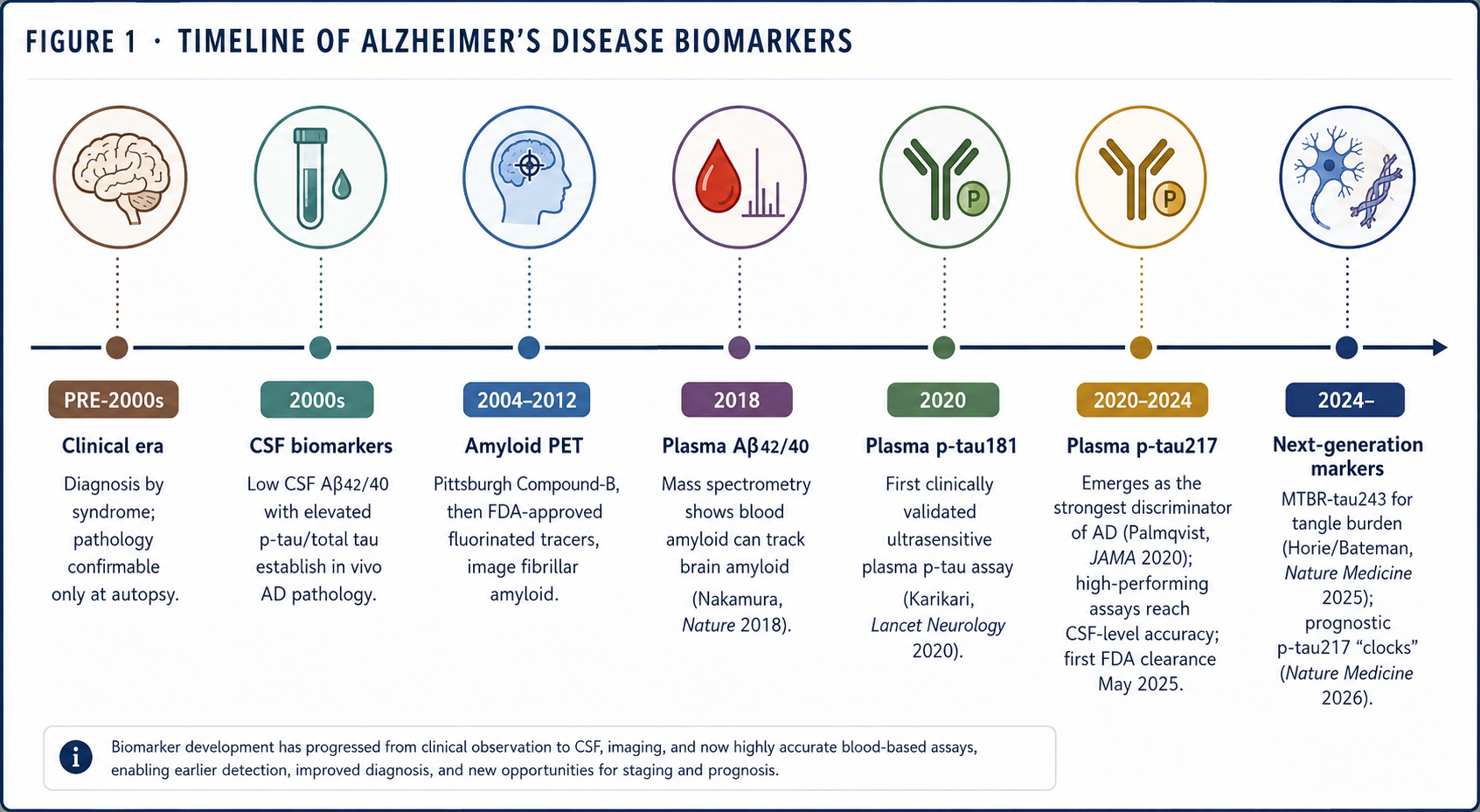
The path from a purely clinical diagnosis to blood-based testing spans roughly two decades — from spinal fluid, to molecular imaging, to progressively more refined plasma analytes.
The biology of p-tau217 — briefly
Amyloid-β plaques and neurofibrillary tangles of hyperphosphorylated tau define AD. Well before tangles form, rising amyloid drives increased phosphorylation and secretion of soluble tau, measurable in CSF and blood. Among the phospho-epitopes studied (threonine 181, 205, 212, 217, 231), p-tau217 shows the largest fold-change between AD and non-AD and the best cross-platform performance (Ashton, Alzheimer’s & Dementia 2025). Importantly, p-tau217 is a soluble-tau response closely associated with cerebral amyloid — not a direct amyloid measurement — and therefore serves clinically as a highly accurate surrogate for amyloid positivity, strongly predicting amyloid-positive biological AD rather than measuring amyloid itself.
Where blood fits: AT(N) and the 2024 criteria
The AT(N) framework groups biomarkers into amyloid (A), pathologic tau (T), and neurodegeneration (N). The 2024 revised criteria refine this and sort biomarkers by when they change (Figure 2). Core 1 biomarkers turn abnormal early — amyloid PET, established CSF ratios, and sufficiently accurate plasma p-tau217; within these criteria, an abnormal Core 1 biomarker may establish AD neuropathologic change. Core 2 biomarkers (tau PET, MTBR-tau243, p-tau205) mark later tau pathology and inform staging. Two caveats matter for practice: these are explicitly biological criteria that have generated debate and are not a universal clinical mandate; and their application depends on the specific assay meeting appropriate performance standards. In routine care, interpretation must remain integrated with the clinical syndrome, assay-specific validation, and intended use.
|
A · Amyloid
Earliest defining pathology
Core 1: amyloid PET, CSF Aβ42/40, plasma Aβ42/40
|
→ |
T1 · Soluble p-tau
Amyloid-responsive tau signal
Core 1 if accurate: plasma p-tau217; also p-tau181, p-tau231
|
→ |
T2 · Tangles
Later tau pathology / staging
Core 2: tau PET, plasma MTBR-tau243, p-tau205
|
|
N · Neurodegeneration
Downstream neuronal injury, not AD-specific
Plasma NfL, MRI atrophy, FDG-PET
|
I · Inflammation / Astrocytic
Reactive biology, useful in panels/prognosis
Plasma GFAP
|
Currently available blood biomarker tests
Two regulatory categories are clinically relevant. An FDA-cleared assay has undergone regulatory review for a defined intended use, which may facilitate institutional adoption and coverage decisions. A laboratory-developed test (LDT) is validated and run under CLIA by a single laboratory; several of the best-studied assays are LDTs but carry no FDA clearance. Table 1 lists the principal orderable U.S. tests, one row per test, with the basis of the reported performance.
| Test (ordering lab) | Biomarker(s) | Platform | Regulatory status | Reported performance (evidence basis) | Intended use / notes |
|---|---|---|---|---|---|
| Lumipulse pTau217/Aβ42 ratio (Fujirebio; also via Labcorp) | p-tau217 / Aβ1-42 ratio | Automated immunoassay | FDA-cleared (May 2025) | Positive predictive value 91.8%, negative predictive value 97.3%, indeterminate 19.6% (FDA 499-sample study vs PET/CSF) | Aid in identifying amyloid pathology associated with AD in adults with signs or symptoms of cognitive decline evaluated in specialized care; not for screening or as a stand-alone testa |
| Elecsys p-tau181 (Roche) | p-tau181 | Automated immunoassay | FDA-cleared (Oct 2025) | NPV ~97.9% (FDA/manufacturer) | Primary-care rule-out of amyloid pathology; not confirmatory |
| PrecivityAD2 / APS2 (C2N Diagnostics) | %p-tau217 + Aβ42/40 | Mass spectrometry | LDT (CLIA) | AUC 0.94; ~88% concordance with amyloid PET (peer-reviewed, Meyer 2024); two-cutoff | Symptomatic (MCI/dementia) |
| AD-Detect Aβ42/40 + p-tau217 (Quest, test 14258) | Aβ42/40 + p-tau217 (Likelihood Score) | Mass spec + immunoassay | LDT (CLIA) | ~91% sensitivity / ~91% specificity (manufacturer data) | Symptomatic; current clinician-ordered panel |
| ALZpath p-tau217 (via Neurocode USA) | p-tau217 | Single-molecule (Simoa) | LDT (CLIA) | AUC 0.92–0.96 (peer-reviewed, Ashton 2024) | Symptomatic; ALZpath is the assay maker, run clinically through a partner laboratory |
| p-tau217, Plasma (Labcorp, test 484390) | p-tau217 | Lumipulse immunoassay | LDT (CLIA) | Per Labcorp validation (laboratory data) | Symptomatic; standalone single-analyte LDT |
| Phospho-Tau 217, Plasma (Mayo Clinic Labs, PT217) | p-tau217 | Lumipulse immunoassay | LDT (CLIA) | Mayo memory-clinic validation (peer-reviewed) | Symptomatic; standalone single-analyte LDT |
a The 510(k) Indications for Use specify adults aged 50 years and older. Availability, platforms, reference intervals, and regulatory status may change; clinicians should verify current specifications with the performing laboratory.
Two practical points. First, values and cutoffs are not interchangeable across platforms; interpret each result against the reporting laboratory’s reference and decision model (single-cutoff vs two-cutoff with a gray zone). Second, the FDA-cleared ratio and the leading peer-reviewed p-tau217 LDTs occupy the high end of performance, but their reported metrics come from different populations and reference standards, so head-to-head superiority should not be assumed.
Comparing the plasma biomarkers
Not all blood markers answer the same question (Table 2). p-tau217 is the workhorse for amyloid status; other analytes mark different points in the cascade and carry different specificities.
| Marker | Reflects | Timing in cascade | Amyloid discrimination | Clinical role / limitation |
|---|---|---|---|---|
| p-tau217 | Amyloid-responsive soluble tau | Early, steep rise; continues into tau stage | AUC often >0.90 (best single marker; varies by assay) | Preferred marker for amyloid status/triage |
| p-tau181 | AD-type soluble tau | Early–intermediate | AUC ~0.85–0.90 | First available; smaller fold-change, being superseded |
| p-tau231 | Tau phosphorylation at Thr231 | May become abnormal at very early or sub-threshold amyloid accumulation | AUC ~0.89–0.94 | Promising research marker for early amyloid-associated change; clinical role less established than p-tau217 |
| Aβ42/40 (plasma) | Amyloid metabolism (ratio falls with plaques) | Early (amyloid phase) | Modest; immunoassay AUC 0.69–0.78, best mass-spec ~0.86 | Small dynamic range → pre-analytically fragile; not recommended alone |
| GFAP | Reactive astrocytosis (amyloid-associated) | Early | Strong amyloid association; below p-tau217 | Not AD-specific; useful in panels/prognosis |
| NfL | Axonal/neuronal degeneration (generic) | Nonspecific | Poor for amyloid | Elevated across many diseases; marker of neurodegeneration/progression |
Clinical interpretation of results
A plasma p-tau217 result is a probability statement conditioned on the clinical context, not a yes/no verdict (Table 3). In a typical amnestic syndrome, a clearly positive result substantially raises the probability of amyloid pathology and a clearly negative result makes AD unlikely; the difficulty lies at the extremes of pretest probability and in the intermediate band, whose strength depends on the assay, its cutoff strategy, and the population.
| Result | Most likely meaning | Suggested action |
|---|---|---|
| Clearly positive (validated assay) | High probability of amyloid pathology — not proof AD is the sole cause | Support AD in a compatible syndrome; before anti-amyloid therapy, confirm amyloid (PET/CSF) and offer APOE genotyping; consider mixed pathology |
| Clearly negative | AD pathology unlikely (high negative predictive value) | Pursue non-AD causes |
| Indeterminate (gray zone) | Uncertain amyloid status | Confirm with CSF or amyloid PET; do not force a diagnosis on a borderline value |
| Positive, atypical syndrome | Possible incidental amyloid or mixed pathology | Interpret cautiously; amyloid is common in unimpaired older adults |
A practical diagnostic algorithm
Blood biomarkers slot into the cognitive evaluation after the syndrome is characterized and reversible causes excluded — they do not replace it.
Subjective complaints with normal testing → reassure, monitor, and do not order plasma biomarkers.
MCI or dementia → continue.
Do not test; continue clinical workup and management.
Order a validated plasma p-tau217 assay; interpret with eGFR, BMI, assay platform, and pretest probability.
| Clearly negative | Clearly positive | Indeterminate |
|---|---|---|
| AD pathology unlikely. | Supports AD biology in a compatible syndrome. | Amyloid status uncertain. |
| Pursue non-AD causes. | If anti-amyloid therapy is planned, confirm amyloid with PET/CSF and offer APOE genotyping. | Do not force interpretation; confirm with CSF or amyloid PET. |
When should general neurologists order p-tau217?
Testing is appropriate when the patient is symptomatic and the result will change management: MCI (identifying MCI due to AD, informing prognosis and therapy eligibility); typical amnestic dementia (confirming the impression without a lumbar puncture); mixed or vascular-burdened presentations (clarifying an AD contribution); younger or atypical presentations (with specialist involvement); and patients being evaluated for disease-modifying therapy (efficient triage). It is not indicated for asymptomatic screening or for cognitively normal adults with subjective complaints.
Practical assay selection. For symptomatic patients with objective cognitive impairment, select a validated assay that meets the intended clinical purpose. High-performing p-tau217-based ratios or percentage measures generally provide the strongest evidence base; plasma Aβ42/40 should not be used alone unless the specific assay has adequate independent validation.
Common pitfalls and confounders
Several conditions shift plasma biomarker concentrations independent of brain pathology (Table 4), though the magnitude and clinical relevance vary by assay. Reduced renal function is the most important: because these markers are cleared peripherally, a lower estimated glomerular filtration rate (eGFR) can raise plasma concentrations and produce false positives. Ratio-based or percentage p-tau217 measures may be less affected by renal function in some studies, although robustness is assay-specific (Bornhorst, Neurology 2025; Mielke, Nature Medicine 2022). Borderline or discordant results in patients with significant renal impairment should be interpreted cautiously and may warrant confirmatory CSF or PET.
| Factor | Possible effect | Markers most affected | Practical management |
|---|---|---|---|
| Reduced renal function (low eGFR) | May raise concentrations (false-positive) | NfL, GFAP, Aβ; p-tau less so | Consider renal function; ratio/percentage measures may be less affected; confirm borderline results with PET/CSF in significant impairment |
| High BMI | May modestly lower concentrations | p-tau217, p-tau181 | Consider as one of several modifiers for borderline values |
| Older age | Modest rise | NfL, GFAP > p-tau | Use age/comorbidity context |
| Acute stroke, TBI, CNS inflammation | Transient rise | NfL, GFAP, total tau | Defer AD panels in the acute setting |
| Non-AD dementias (DLB, PDD, vascular) | Positive when AD co-pathology present | p-tau217 | Read as “AD co-pathology present,” not primary diagnosis |
| Frontotemporal dementia | Typically normal | p-tau217 low | Low p-tau217 reduces AD likelihood; a raised NfL indicates neuroaxonal injury but is not specific for FTD |
Across pathologies, p-tau217 generally distinguishes AD from frontotemporal degeneration well, whereas discrimination from Lewy body and vascular syndromes is less straightforward because AD co-pathology is common (Chai, Alzheimer’s Research & Therapy 2026). A positive result in these settings signals a contributing AD process, not exclusion of the primary diagnosis.
Blood biomarkers and anti-amyloid therapy
With lecanemab and donanemab available for early symptomatic AD, confirming amyloid before treatment is essential — the drugs are indicated only in amyloid-positive patients, and amyloid-related imaging abnormalities (ARIA) are a real risk (ARIA-with-edema occurred in roughly 13% of lecanemab- and 24% of donanemab-treated trial participants). The 2025 Alzheimer’s Association guideline supports sufficiently accurate blood biomarkers as either triage or confirmatory tools within specialty diagnostic evaluation, depending on performance thresholds. Treatment pathways, however, remain more conservative and institution-dependent: amyloid confirmation is required before initiating therapy, and most current programs rely on PET or CSF, reflecting the pivotal trials and appropriate-use recommendations (Cummings, J Prev Alzheimers Dis 2023; Rabinovici, J Prev Alzheimers Dis 2025). In this pathway, a positive plasma p-tau217 can prioritize patients for definitive amyloid confirmation according to the treatment program’s protocol, and a clearly negative result averts unnecessary testing. APOE genotyping should be offered after appropriate counseling to inform ARIA risk.
Future directions
The next phase moves beyond detecting amyloid. MTBR-tau243, a plasma fragment reflecting insoluble tau tangles, correlates with tau PET and cognition and rises later than p-tau217 — a blood marker of disease stage rather than amyloid status (Horie/Bateman, Nature Medicine 2025). p-tau231 (early amyloid) and GFAP (astrocytic reactivity) may sharpen preclinical detection, and multi-marker AT(N) panels promise integrated profiling. Prognostic p-tau217 “clock” models estimate time to symptom onset within a few years in research cohorts (Nature Medicine 2026). Longer term, blood testing points toward monitoring, risk stratification, and precision trial enrollment — though screening of asymptomatic individuals remains premature and outside current guidelines.
- Plasma p-tau217 is currently the most consistently validated blood biomarker for identifying AD amyloid pathology — a soluble-tau surrogate that strongly predicts amyloid-positive biological AD (AUC often >0.90, varying by assay).
- The Fujirebio Lumipulse p-tau217/Aβ42 ratio is the first FDA-cleared AD blood test (2025); leading p-tau217 LDTs are strong performers but not FDA-cleared.
- Test symptomatic patients (MCI or dementia) only; do not screen asymptomatic or cognitively normal people.
- Order only when the result will change management.
- A clearly positive result from a sufficiently validated assay indicates a high probability of amyloid pathology; it does not establish that AD is the sole cause of the syndrome.
- A clearly negative result has high negative predictive value and argues against AD.
- Indeterminate (gray-zone) results still require confirmatory CSF or amyloid PET.
- Consider renal function and other assay-specific modifiers when interpreting borderline or discordant results.
- Before anti-amyloid therapy, confirm amyloid (most pathways use PET or CSF) and offer APOE genotyping after counseling; a blood test alone is generally not sufficient to treat.
- Values and cutoffs are not interchangeable across assays; interpret each against the reporting laboratory’s reference.
Conclusion
Blood-based biomarkers represent a major advance in the evaluation of symptomatic cognitive impairment. Plasma p-tau217 is currently the most consistently validated blood biomarker for identifying AD amyloid pathology, with several assays demonstrating performance approaching established CSF- and PET-based pathways in appropriately selected patients. Its clinical value depends on the specific assay, intended use, pretest probability, and disciplined interpretation. Clearly positive and negative results may reduce the need for more invasive testing, whereas indeterminate or discordant results still require CSF or amyloid PET. Blood biomarkers do not replace syndrome characterization and do not establish that AD is the sole cause of cognitive impairment. Their greatest current role is to improve diagnostic efficiency and guide selection for definitive testing, while emerging markers such as MTBR-tau243 may ultimately extend blood testing from detection toward biological staging and prognosis.
Selected references
- Jack CR Jr, et al. Revised criteria for diagnosis and staging of Alzheimer’s disease: Alzheimer’s Association Workgroup. Alzheimers Dement 2024;20:5143–5169.
- Palmqvist S, et al. Discriminative accuracy of plasma p-tau217 for Alzheimer disease. JAMA 2020;324:772–781.
- Ashton NJ, et al. Diagnostic accuracy of the plasma ALZpath p-tau217 immunoassay. JAMA Neurol 2024;81:255–263.
- Ashton NJ, et al. Multi-assay comparison of plasma p-tau epitopes (GBSC Round Robin). Alzheimers Dement 2025;21:e14508.
- Palmqvist S, et al. Alzheimer’s Association clinical practice guideline on blood-based biomarkers. Alzheimers Dement 2025.
- Meyer MR, et al. Clinical validation of the PrecivityAD2 blood test (%p-tau217, Aβ42/40). Alzheimers Dement 2024.
- Horie K, et al. Plasma MTBR-tau243 identifies tau tangle pathology in Alzheimer’s disease. Nat Med 2025;31:2044–2053.
- Bornhorst JA, et al. Effect of kidney function on plasma p-tau217. Neurology 2025;104:e210287.
- Mielke MM, et al. Plasma biomarker performance and effect of comorbidities. Nat Med 2022;28:1398–1405.
- Cummings J, et al. Lecanemab appropriate use recommendations. J Prev Alzheimers Dis 2023;10:362–377.
- Rabinovici GD, et al. Donanemab appropriate use recommendations. J Prev Alzheimers Dis 2025;12:100150.
- van Dyck CH, et al. Lecanemab in early Alzheimer’s disease (Clarity AD). N Engl J Med 2023;388:9–21.
- Sims JR, et al. Donanemab in early symptomatic Alzheimer disease (TRAILBLAZER-ALZ 2). JAMA 2023;330:512–527.
- U.S. FDA. 510(k) K242706 (Lumipulse pTau217/β-Amyloid 1-42 Plasma Ratio), May 2025; FDA Class II recall notice (2025–2026).